
In Erinnerung an Sir Patrick Stewart · 1940 bis 2026Die 20 Sätze von Jean-Luc Picard

BuchKnall Case Files · No. 3

The visitor ʻOumuamua

Solar System, autumn 2017

In the autumn of 2017 astronomers spot a point of light flying straight through our Solar System. It comes from outside, from the space between the stars. Nobody had ever seen such a thing before. By the time it is noticed, it is already on its way out. To this day nobody knows for certain what it was.

Open the file with sound Open without sound

Scroll to read. The switch shows two layers: “Measured” is what the telescopes recorded. “Theories” is what researchers conclude from it. With music. Switch the sound off at the switch.

  1. Before September 2017From the direction of Lyra

    1.3 billion km from the Sun · 30 km/s

    Nobody sees it coming

    The planets all circle the Sun in roughly the same flat disc, like marbles on a tabletop. The object in this file approaches that disc at a steep angle from above.

    It comes from the direction of the constellation Lyra and has been travelling between the stars for a very long time, perhaps hundreds of millions of years.

    On September 2, 2017, it dives through the disc, closer to the Sun than Mercury, the innermost planet. No telescope has noticed it.

    For this station there is only the measurement.

  2. September 9, 2017Close to the Sun

    38 million km from the Sun · 87 km/s

    Once around the Sun

    On September 9 it comes closest to the Sun: 38 million kilometers. For comparison, Earth is about 150 million kilometers from the Sun, four times as far.

    The Sun’s gravity pulls it into a tight curve and makes it faster and faster. At the tightest point it travels about 87 kilometers per second. A rifle bullet manages about one.

    Then it heads back out. The Sun cannot capture it. It is too fast for that.

    For this station there is only the measurement.

  3. October 14, 2017Close to Earth

    166 million km from the Sun · 48 km/s

    Sixty times as far as the Moon

    On October 14 it flies past Earth at a distance of 24 million kilometers. That is about sixty times as far away as the Moon. For astronomers that is close.

    It never comes closer again. Still nobody has noticed it: it is small and reflects very little light.

    On October 14 it flies past Earth at a distance of 24 million kilometers. That is about sixty times as far away as the Moon. For astronomers that is close.

    It never comes closer again. Still nobody has noticed it: it is small and reflects very little light.

    For this station there is only the measurement.

  4. October 19, 2017Haleakalā, Hawaii

    183 million km from the Sun · 46 km/s

    A dot that moves too fast

    The Pan-STARRS 1 telescope stands on the Haleakalā volcano in Hawaii. It photographs the sky every night to find asteroids that come near Earth.

    On October 19 astronomer Rob Weryk notices a point of light in the images. It moves in a way no asteroid or comet from our Solar System would. Weryk finds the same dot in the previous night’s images too.

    So it is discovered, five days after flying past Earth. By then it is already on its way out.

    For this station there is only the measurement.

  5. Late October 2017Pasadena, California

    190 million km from the Sun · 45 km/s

    A path with no return

    Everything that belongs to the Sun circles it. Planets and comets fly on closed paths and keep passing the same spot, as on a racetrack.

    The path of this object is open. It comes in from outside, swings around the Sun and disappears back out. Specialists call such a curve a hyperbola. It only happens when something is too fast for the Sun to hold on to.

    That settles it: the object comes from outside our Solar System. Davide Farnocchia calculates such paths at NASA. He calls this one the most extreme he has ever seen.

    For this station there is only the measurement.

  6. October 25 to 27, 2017Very Large Telescope, Chile

    206 million km from the Sun · 45 km/s

    All we ever saw

    Now the largest telescopes in the world turn toward it. Time is short: it is moving away and grows fainter every day.

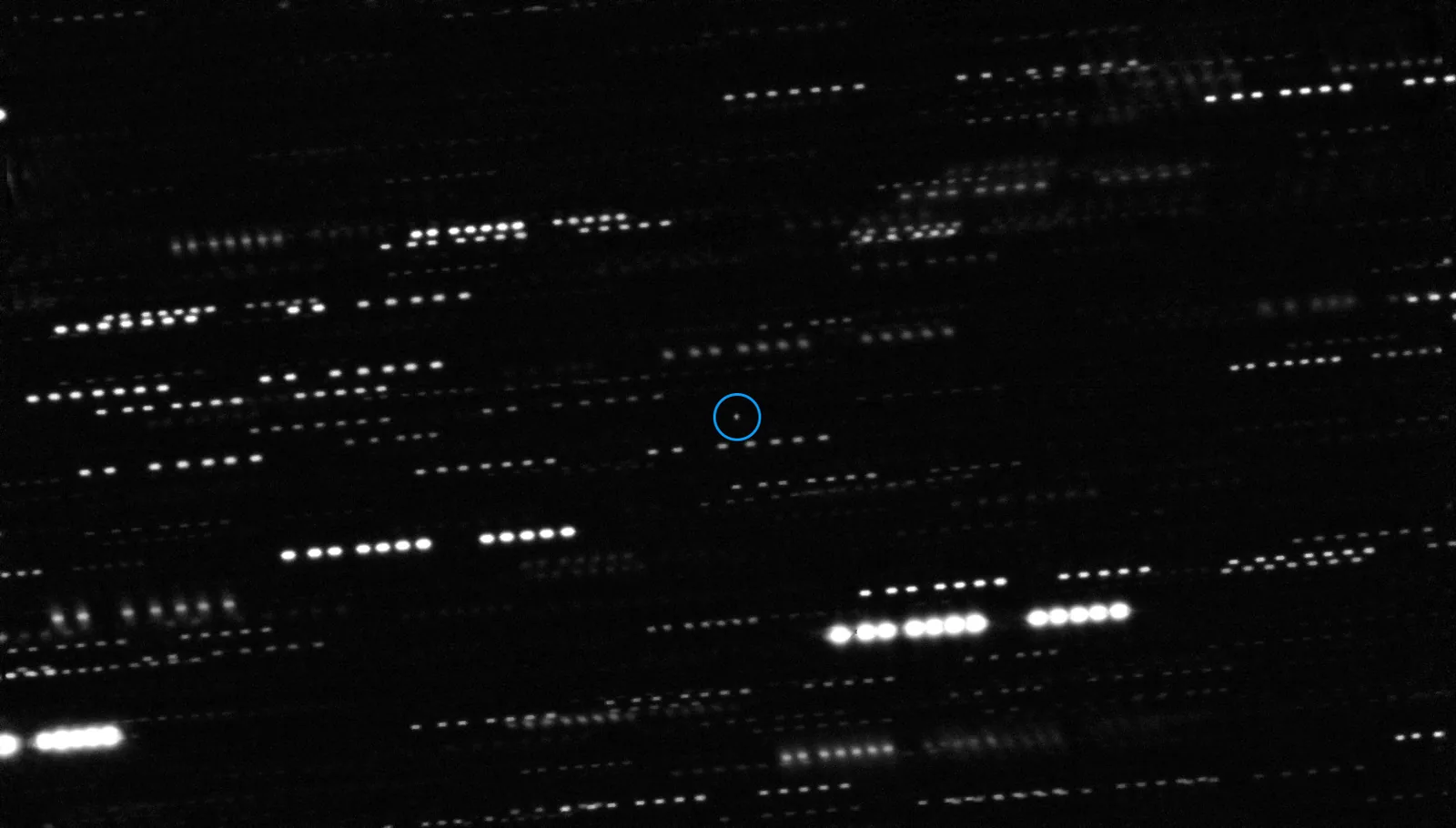
    Even in the Very Large Telescope in Chile it remains a single point of light. It is too small and too far away to make out any detail.

    The researchers look for a tail or an envelope of gas and dust, as comets have. They find neither. That dot is all any human has ever seen of it.

    For this station there is only the measurement.

    The dot in the circle is ʻOumuamua, imaged with the Very Large Telescope and others. The streaks are stars. They smear because the telescopes followed the fast-moving object. Image: ESO/K. Meech et al., CC BY 4.0.

  7. November 2017The brightness

    270 million km from the Sun · 41 km/s

    Ten times brighter, ten times fainter

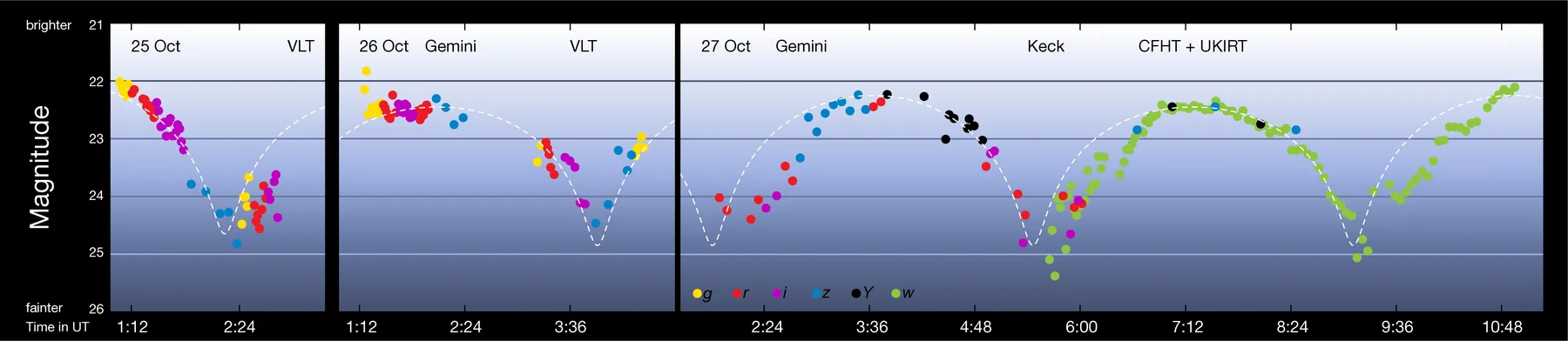
    The point of light grows brighter and fainter at regular intervals. The object spins once every 7.3 hours, and as it does its brightness changes by a factor of ten. The record of that change is called a light curve.

    From it the shape can be estimated. Picture a pencil turning in the light of a lamp. When its long side faces you, it reflects a lot of light. When the tip faces you, almost none. Only something very elongated varies that much.

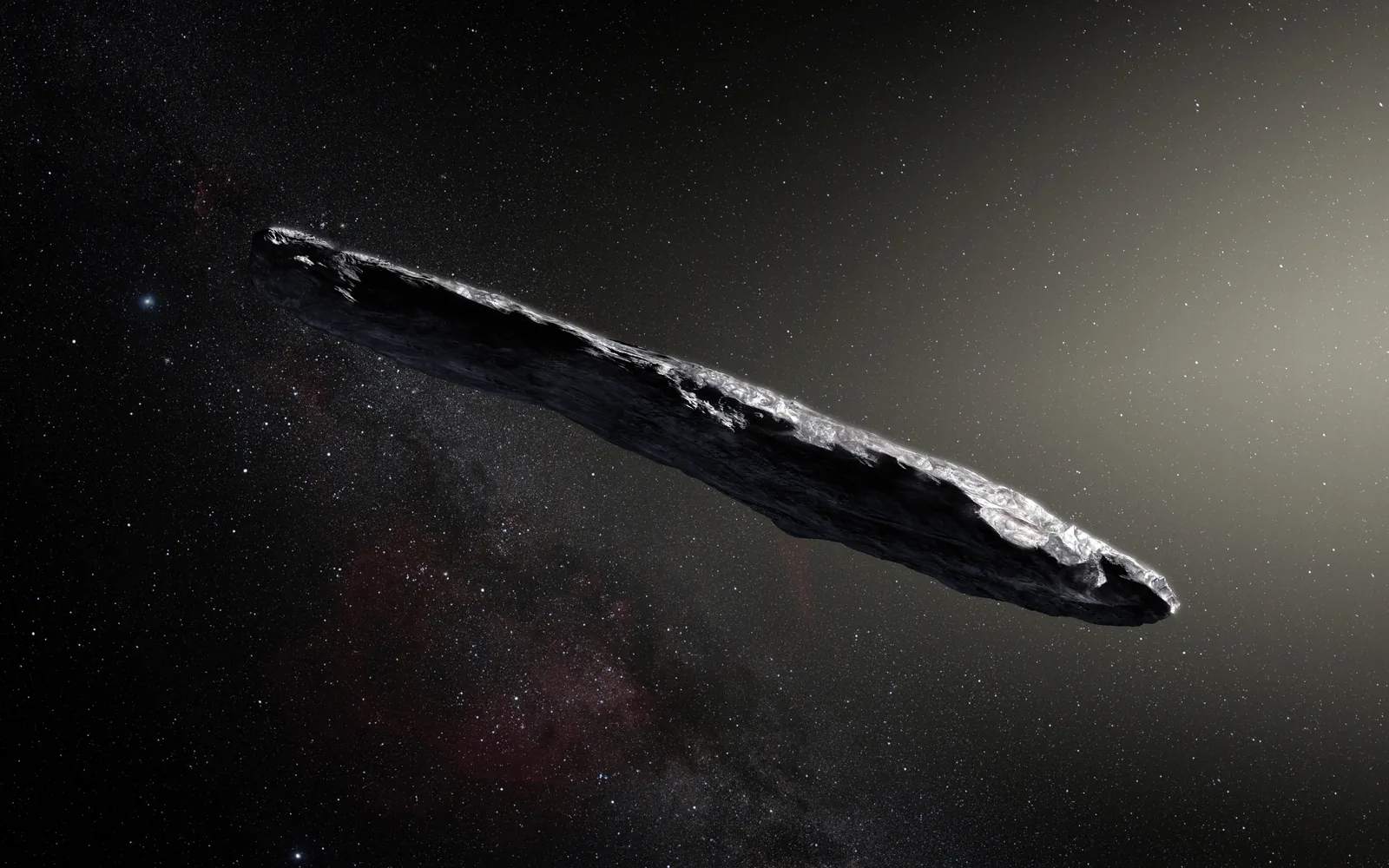
    The researchers infer a dark red object, at least 400 meters long and about ten times as long as it is wide. The familiar cigar picture was drawn by an artist on that basis. No photograph of the shape exists.

    Theory from2019 · 2 years later

    Sergey Mashchenko, 2019 study

    He works through the light curve again. His result: a flat disc fits the measurements even better than a cigar. That would make ʻOumuamua look more like a pancake.

    The light curve: how its brightness changed over three nights in October 2017. Each dot is one measurement. Up is bright, down is faint. The colors stand for different color filters on the cameras. Image: ESO/K. Meech et al., CC BY 4.0.What ʻOumuamua might look like. This is an artist’s impression, not a photograph. Image: ESO/M. Kornmesser, CC BY 4.0.

  8. November 2017Hawaii

    300 million km from the Sun · 40 km/s

    The messenger who came first

    Astronomers create a new category for it. It is called I for interstellar, which means “between the stars”. It gets the number 1I because it is the first known object of its kind.

    The team in Hawaii names it ʻOumuamua, pronounced roughly “oh-MOO-uh-MOO-uh”. That is Hawaiian and means roughly: a messenger from afar arriving first.

    The author Arthur C. Clarke imagined such a visit back in 1973. In his novel “Rendezvous with Rama” an elongated object flies into the Solar System from outside, and astronomers first take it for an asteroid. In Clarke’s book it is a spacecraft.

    For this station there is only the measurement.

    What ʻOumuamua might look like. This is an artist’s impression, not a photograph. Image: ESO/M. Kornmesser, CC BY 4.0.

  9. December 13, 2017Green Bank, USA

    370 million km from the Sun · 38 km/s

    Radio silence

    What if it is a device? Then it might be transmitting. The Breakthrough Listen project uses radio telescopes to search for radio signals from other civilizations. It points the Green Bank telescope in the United States at ʻOumuamua.

    Ten hours of listening are planned across a wide range of radio frequencies, and the first shift runs on December 13. According to the project, the telescope would pick up a transmitter with the power of a cellphone in under a minute.

    The analysis finds no artificial signal. ʻOumuamua stays silent.

    For this station there is only the measurement.

  10. Act two · What pushed it?

    June 27, 2018The journal Nature

    930 million km from the Sun · 31 km/s

    Faster than it should be

    Anything flying away from the Sun slows down, because the Sun’s gravity pulls it back. By how much can be calculated precisely in advance.

    A team led by astronomer Marco Micheli compares that calculation with measurements from the Hubble telescope and the large telescopes on the ground. ʻOumuamua is slowing down less than it should. Something is gently pushing it away from the Sun.

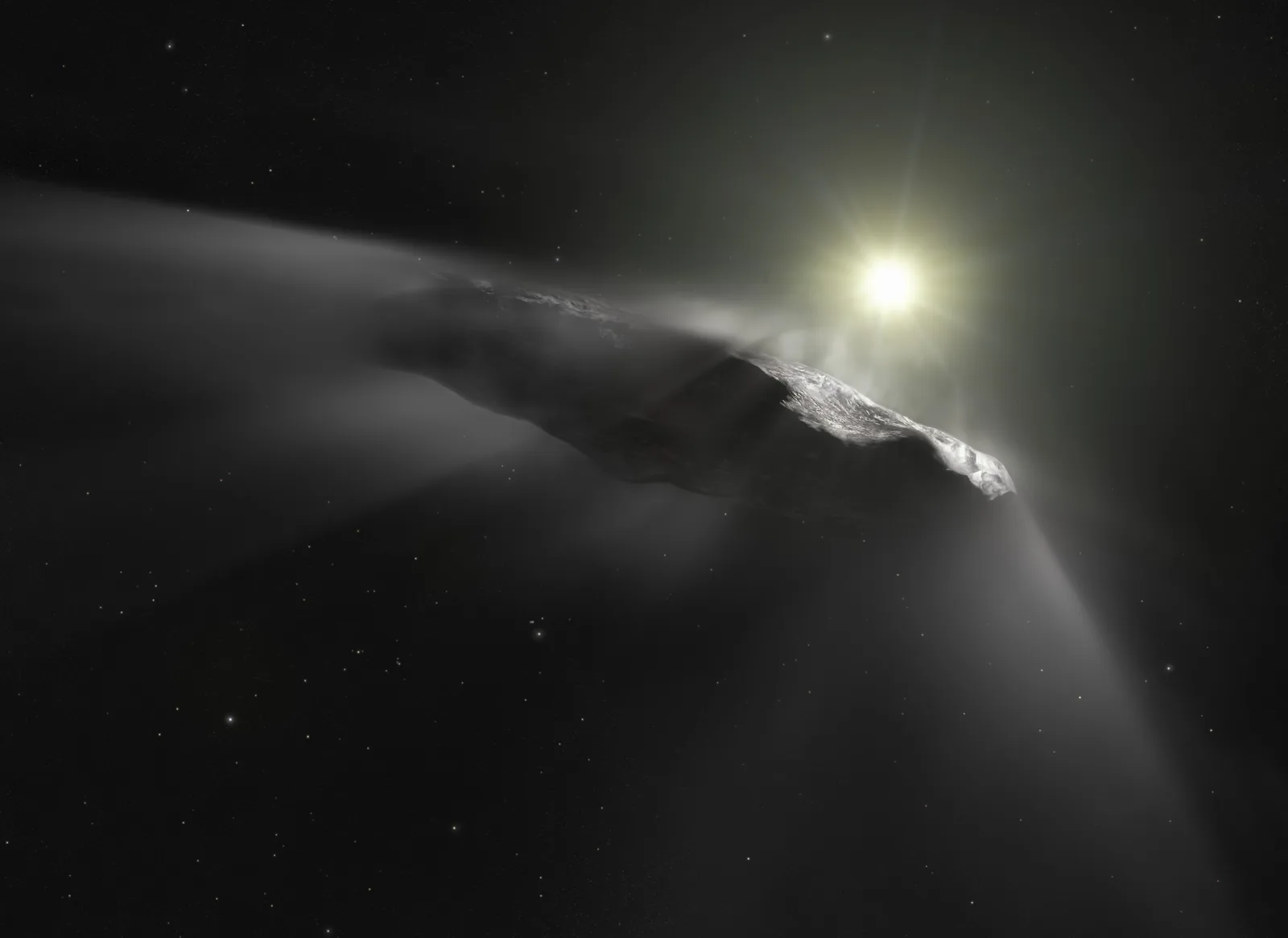
    Comets are known to do this. They are made of ice and dust. In the Sun’s warmth the ice evaporates, the gas streams out and acts like a weak jet. But that also produces the tail. On ʻOumuamua no telescope found any gas or dust.

    Theory from2018 · 1 years later

    Marco Micheli and his team

    They stay with the comet explanation. To them ʻOumuamua is a tiny, weird comet. It vents gas or coarse dust that no telescope could detect.

    The comet explanation, drawn by an artist: gas streams out and pushes the object. Nobody observed this happening. Image: ESA/Hubble, NASA, ESO, M. Kornmesser, CC BY 4.0.

  11. November 2018Harvard

    1.3 billion km from the Sun · 30 km/s

    Thinner than a millimeter

    Two astronomers at Harvard University, Shmuel Bialy and Avi Loeb, work through another possibility: sunlight itself could be pushing it.

    Light presses very gently on everything it hits. On a boulder you would never notice. On something very thin and light the pressure is enough to speed it up, the way wind drives a sail.

    By their calculation ʻOumuamua would have to be thinner than a millimeter for that. Such a thing is called a light sail. Nothing comparable has been found in nature so far. Humans have already built such sails and tested them in space.

    Theory from2018 · 1 years later

    Shmuel Bialy and Avi Loeb

    They consider it possible that ʻOumuamua is artificial: a light sail drifting through space as debris, or one that someone sent on purpose.

  12. July 1, 2019Bern

    1.9 billion km from the Sun · 29 km/s

    Fourteen astronomers reply

    Fourteen astronomers from the United States and Europe go back through all the data. They check whether any of it points to an artificial object.

    Their finding appears in the journal Nature Astronomy: ʻOumuamua has a natural origin. By their analysis there is a whole range of natural processes that could explain it.

    One of the two leads, Matthew Knight, adds that nothing like ʻOumuamua has ever been seen in the Solar System, and that it is really a mystery still.

    Theory from2023 · 6 years later

    Jennifer Bergner and Darryl Seligman

    Their proposal: on the long journey between the stars, cosmic rays produced hydrogen in the object’s water ice, and it stayed trapped there. In the Sun’s warmth that gas escaped and pushed it. It would leave no visible tail.

    What ʻOumuamua might look like. This is an artist’s impression, not a photograph. Image: ESO/M. Kornmesser, CC BY 4.0.

  13. 2019 and 2025Crimea and Chile

    The next ones

    For almost two years ʻOumuamua remains the only one. On August 30, 2019, amateur astronomer Gennadiy Borisov in Crimea discovers the second visitor from outside. 2I/Borisov has a tail and looks like an ordinary comet.

    On July 1, 2025, the ATLAS survey in Chile reports the third. 3I/ATLAS travels at about 209,000 kilometers per hour, according to NASA faster than any visitor before it. By our trajectory calculation ʻOumuamua arrived at about 95,000. Dozens of telescopes and spacecraft observe 3I/ATLAS, and the James Webb Space Telescope finds methane.

    Both look like comets. ʻOumuamua looked different.

    For this station there is only the measurement.

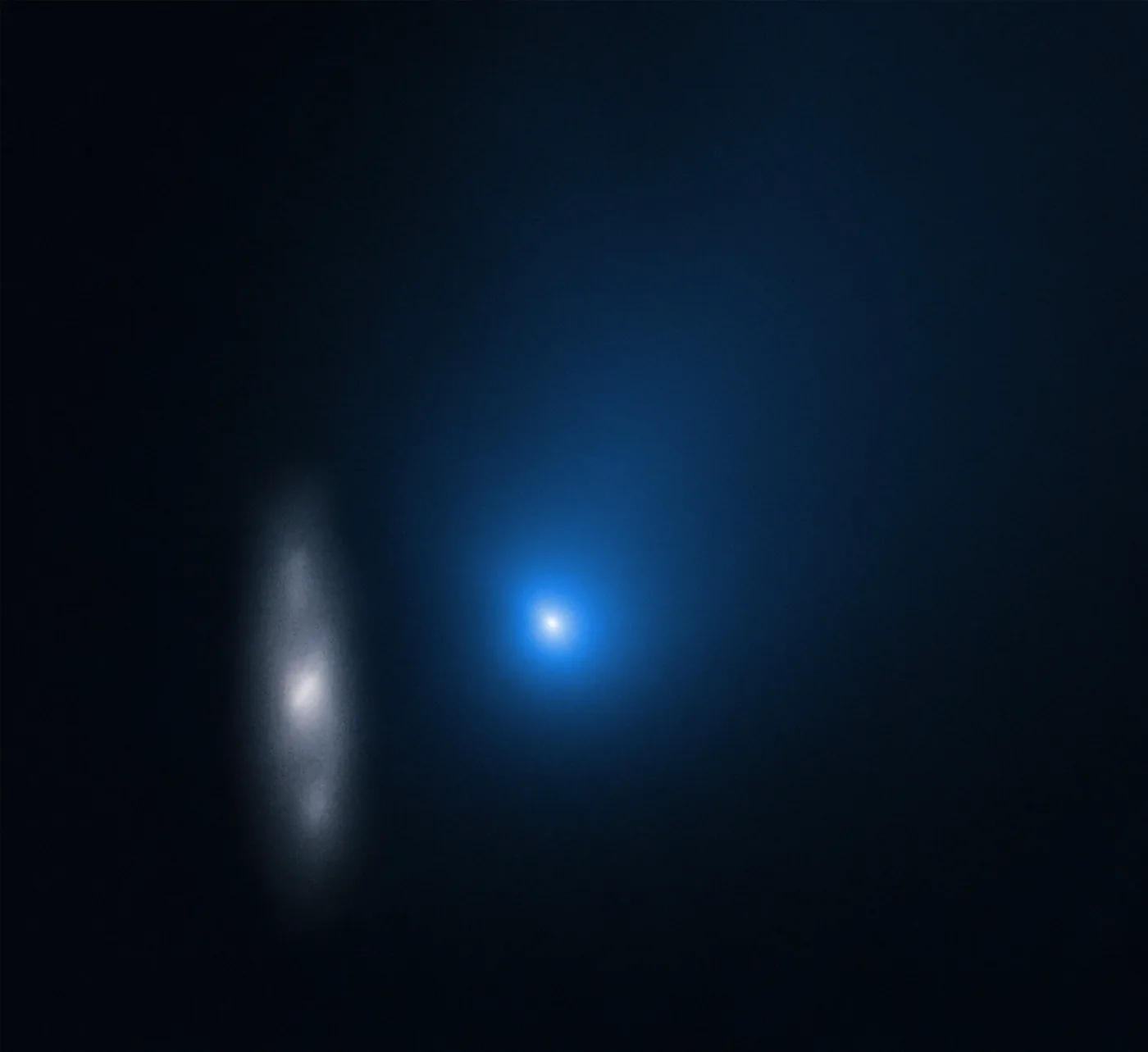
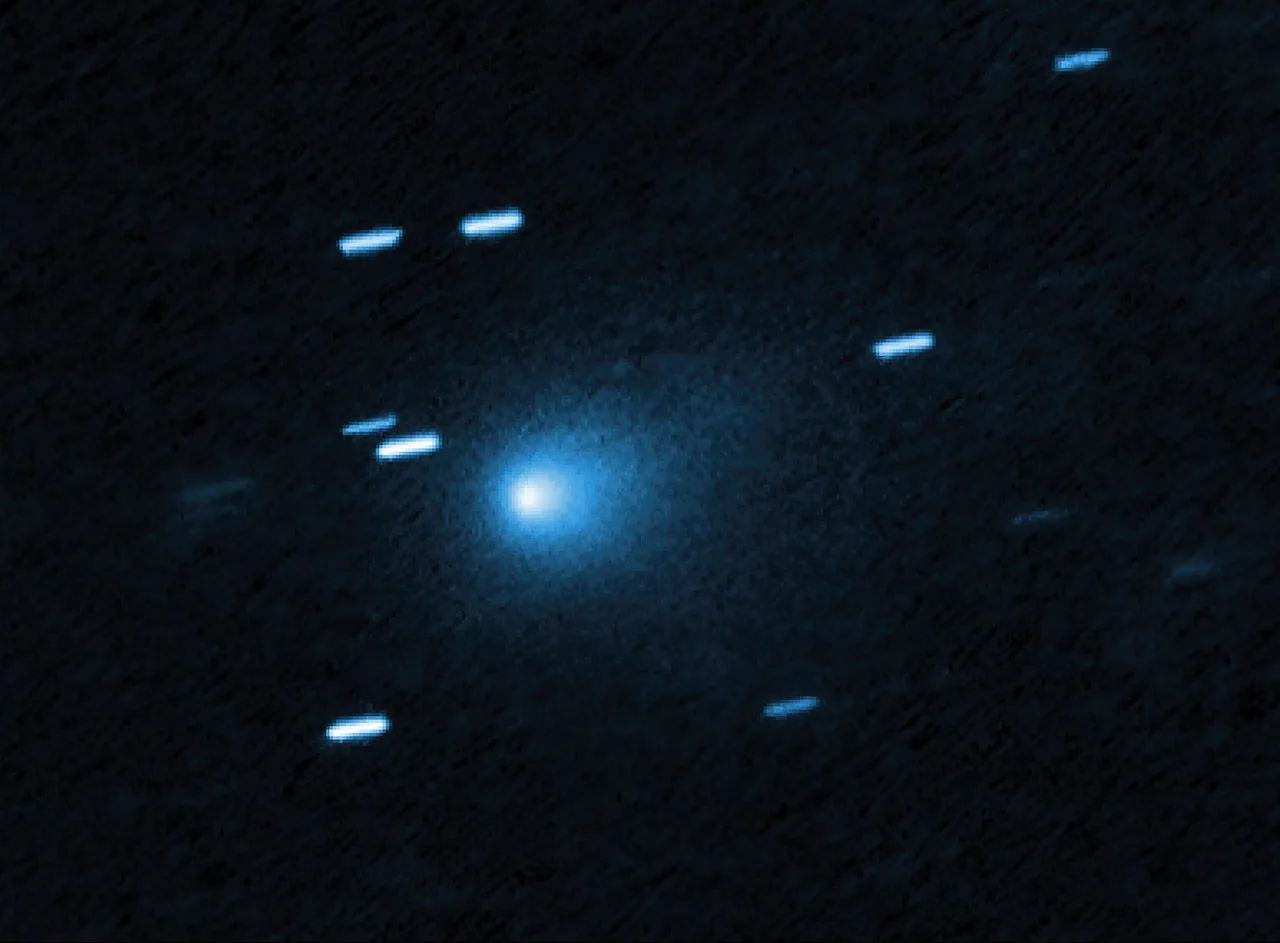
    The second visitor: comet 2I/Borisov, imaged by the Hubble telescope in 2019. Image: NASA, ESA, D. Jewitt (UCLA), CC BY 4.0.The third visitor: comet 3I/ATLAS on July 21, 2025. Image: NASA, ESA, David Jewitt (UCLA), processing Joseph DePasquale (STScI).

  14. November 2026Beyond Neptune

    8.3 billion km from the Sun · 27 km/s

    It is not coming back

    By our trajectory calculation ʻOumuamua is now about 55 times as far from the Sun as Earth is. That is far beyond Neptune, the outermost planet. No telescope can see it any more.

    It is heading toward the constellation Pegasus and will never return. Nothing more can be measured. What remains of it is a few weeks of data and a point of light on a handful of images.

    For this station there is only the measurement.

    To the live view: where is it now?

LIVE

Where ʻOumuamua is right now

No one has seen it since January 2, 2018. But its path is fixed, and from that path its position can be worked out for any second. This display does the maths in your browser and will still be right a hundred years from now.

Distance from the Sun

8,285,052,594 km

55.38 AU · sunlight takes 7 h 40 min

Speed
27.01 km/s
97,200 km/h
Above the plane of the planets
21.4 AU
3,197 million km
Since discovery
3,314 days
Since you opened this page
+ 0 km

One AU (astronomical unit) is Earth’s distance from the Sun, about 150 million kilometres or 93 million miles.

The route

The list is sorted by distance from the Sun. The five probes are the only spacecraft leaving the solar system. ʻOumuamua is faster than any of them and leaves them behind one by one. The probes are flying in other directions; only the distance from the Sun is compared.

  1. Neptune’s orbit the outermost planet 30.1 AU passed in June 2022
  2. Outer edge of the Kuiper Belt a ring of icy bodies beyond Neptune, home of Pluto about 50 AU passed in December 2025
  3. ʻOumuamua the visitor 55.4 AU now
  4. New Horizons spacecraft, launched 2006 66.1 AU will be overtaken in August 2030 · in 3 years, 9 months
  5. Pioneer 11 spacecraft, launched 1973 118.2 AU will be overtaken in October 2045 · in 18 years
  6. Edge of interstellar space At about this distance Voyager 1 left the bubble blown by the solar wind in August 2012. Nobody knows exactly where the edge lies in ʻOumuamua’s direction. about 120 AU reached in April 2038 · in 11 years
  7. Pioneer 10 spacecraft, launched 1972 142.2 AU will be overtaken in May 2054 · in 27 years
  8. Voyager 2 spacecraft, launched 1977 144.5 AU will be overtaken in March 2063 · in 36 years
  9. Voyager 1 spacecraft, launched 1977 172.4 AU will be overtaken in June 2083 · in 56 years
  10. One light-day how far light travels in 24 hours 173.1 AU reached in October 2047 · in 20 years
  11. The Sun’s focal line From here on the Sun’s gravity focuses the light of distant stars like a lens. NASA researchers have studied how a telescope could be sent there. about 550 AU reached in February 2115 · in 88 years
  12. A thousand times Earth’s distance a round number as a waypoint 1,000 AU reached in the year 2195 · in about 170 years
  13. Inner edge of the Oort Cloud a presumed shell of billions of comets, never observed directly about 2,000 AU reached in the year 2375 · in about 350 years
  14. One light-year how far light travels in a year 63,241 AU reached around the year 13,400 · in about 11,300 years
  15. The distance to the nearest star Proxima Centauri, 4.2 light-years. ʻOumuamua is not headed there; the figure is only a yardstick. 268,550 AU at its speed that distance would take about 48,200 years

Calculated, not measured. The basis is orbit solution 16 from NASA’s Jet Propulsion Laboratory, built on 207 observations over 80 days. Our calculation stays within 0.1 percent of JPL’s through the year 2127. How good the orbit itself is can no longer be checked, because there has been no new observation since 2018. The last digits of the kilometre figure are therefore calculation, not measurement.

Unresolved facts

1

What pushed it?

The push was measured. Nobody saw what caused it. Invisible gas would be one explanation, the pressure of sunlight another. Each needs an assumption that can no longer be checked, because the object is too far away.

2

What did it look like?

Long like a cigar or flat like a disc. The way its brightness changed fits both, and no photograph of its shape exists.

3

Where did it come from?

It came from the direction where the bright star Vega stands today. But stars themselves drift through the Milky Way. When ʻOumuamua passed that spot some 300,000 years ago, Vega was somewhere else. Nobody knows which star it came from.

4

Was it the rule or the exception?

Astronomer Matthew Knight said in 2019: if we find ten to twenty of these visitors and ʻOumuamua still looks unusual, we will have to reexamine our explanations. So far we know three, and the other two are comets.

Is that true?

Six claims about ʻOumuamua that you often read. Tap a card to see how much of each was actually measured.

In their own words

Six lines from researchers who worked on ʻOumuamua and its successors. Each comes with the place where you can read it.

“This object came from outside our solar system.”

Rob Weryk, discovererUniversity of Hawaii, October 2017NASA/JPL, October 26, 2017

“We have been waiting for this day for decades.”

Paul ChodasManager of the Center for Near-Earth Object Studies at JPL, October 2017NASA/JPL, October 26, 2017

“We think this is a tiny, weird comet.”

Marco MicheliEuropean Space Agency, June 2018ESA/Hubble, June 27, 2018

“The true nature of this enigmatic interstellar nomad may remain a mystery.”

Olivier HainautEuropean Southern Observatory, June 2018ESA/Hubble, June 27, 2018

“We have never seen anything like ʻOumuamua in our solar system. It’s really a mystery still.”

Matthew KnightUniversity of Maryland, June 2019University of Maryland, June 28, 2019

“No one knows where the comet came from. It’s like glimpsing a rifle bullet for a thousandth of a second.”

David Jewitton the third visitor 3I/ATLAS, August 2025NASA, Hubble release 2025

Sources

Image credits

  • Zeichnung ʻOumuamua: ESO/M. Kornmesser. Aufnahme und Lichtkurve: ESO/K. Meech et al. Alle drei CC BY 4.0 (creativecommons.org/licenses/by/4.0).
  • Zeichnung der Ausgasung: ESA/Hubble, NASA, ESO, M. Kornmesser, CC BY 4.0. Komet 2I/Borisov: NASA, ESA, D. Jewitt (UCLA), CC BY 4.0.
  • Komet 3I/ATLAS: NASA, ESA, David Jewitt (UCLA), Bildbearbeitung Joseph DePasquale (STScI).
  • Karte der Bahn und Liveansicht: von BuchKnall gerechnet und gezeichnet.
  • Musik: „Mystery Music Loop“ von dziiten (Vorspann) und „Deep Space Garage Band“ von freesound_community, beide von Pixabay.

How this file was made

Every statement on this page comes from the sources listed below. Where researchers disagree, we leave the question open. The map shows the Solar System from above. We calculated the flight path ourselves from the orbital data published by NASA’s Jet Propulsion Laboratory. The orbits of the planets are simplified as circles. Distance and speed at each station come from the same calculation. Two images are drawings by artists at ESO and ESA, as their captions say.