
In Erinnerung an Sir Patrick Stewart · 1940 bis 2026Die 20 Sätze von Jean-Luc Picard

BuchKnall Case Files · No. 2

Operation Highjump

Antarctica, southern summer 1946–47

A year after the Second World War the US Navy sends 13 ships and 4,700 men to Antarctica. A few weeks later the fleet leaves again. On the voyage home the admiral says one sentence that has not gone quiet since.

Open the file with sound Open without sound

Scroll to read. The switch shows two layers: “Logbook” is what the Navy’s records say. “Legend” is what was later made of it. With a blizzard in the opening and music after it. Switch the sound off at the switch.

  1. August 26, 1946Washington, D.C.

    The order

    A year after the end of the war the US Navy plans a large voyage to Antarctica. Officially it is called the Antarctic Developments Project. It becomes known as Operation Highjump.

    The plan calls for 13 ships and about 4,700 men. Rear Admiral Richard H. Cruzen commands the fleet. The best-known man aboard is the famous polar aviator Richard E. Byrd.

    What is it all for? On November 12 Byrd says it is primarily a military mission to train naval personnel. Science comes second.

    Told since1975 · 28 years later

    The legend, in this form since the mid-1970s

    Nobody sends that many ships just to take photographs, the legend says. The real target, it claims, was a secret base in the ice that was on no map.

    The orders do contain an aim the Navy did not talk about in public: the United States was to secure as much of Antarctica as possible.

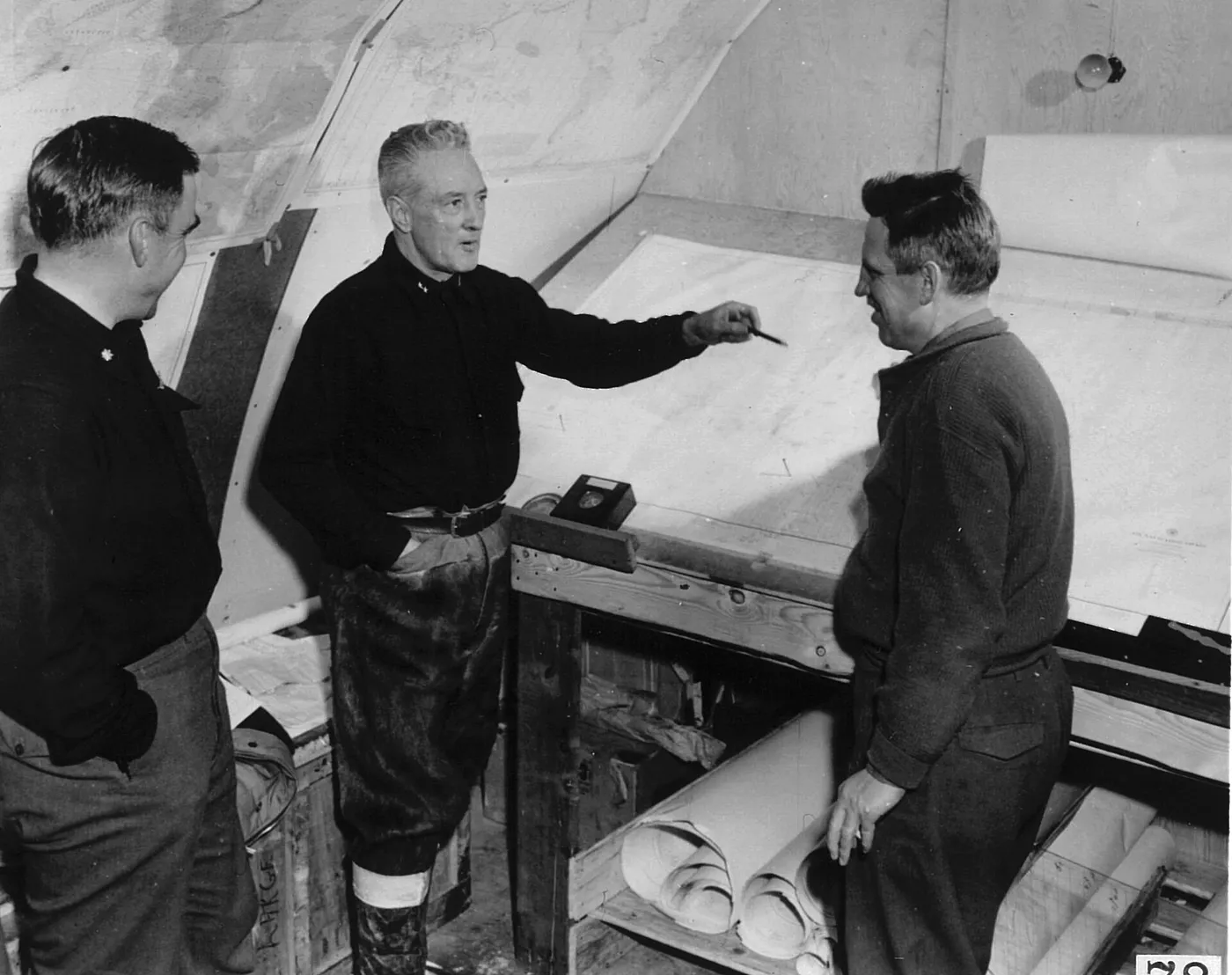
    Rear Admiral Richard E. Byrd with officers at the chart table, Operation Highjump. Photo: US Navy.

  2. December 2, 1946Norfolk and San Diego

    The fleet sails

    The first ships leave Norfolk on the US East Coast and San Diego on the Pacific. The aircraft carrier Philippine Sea follows on January 2.

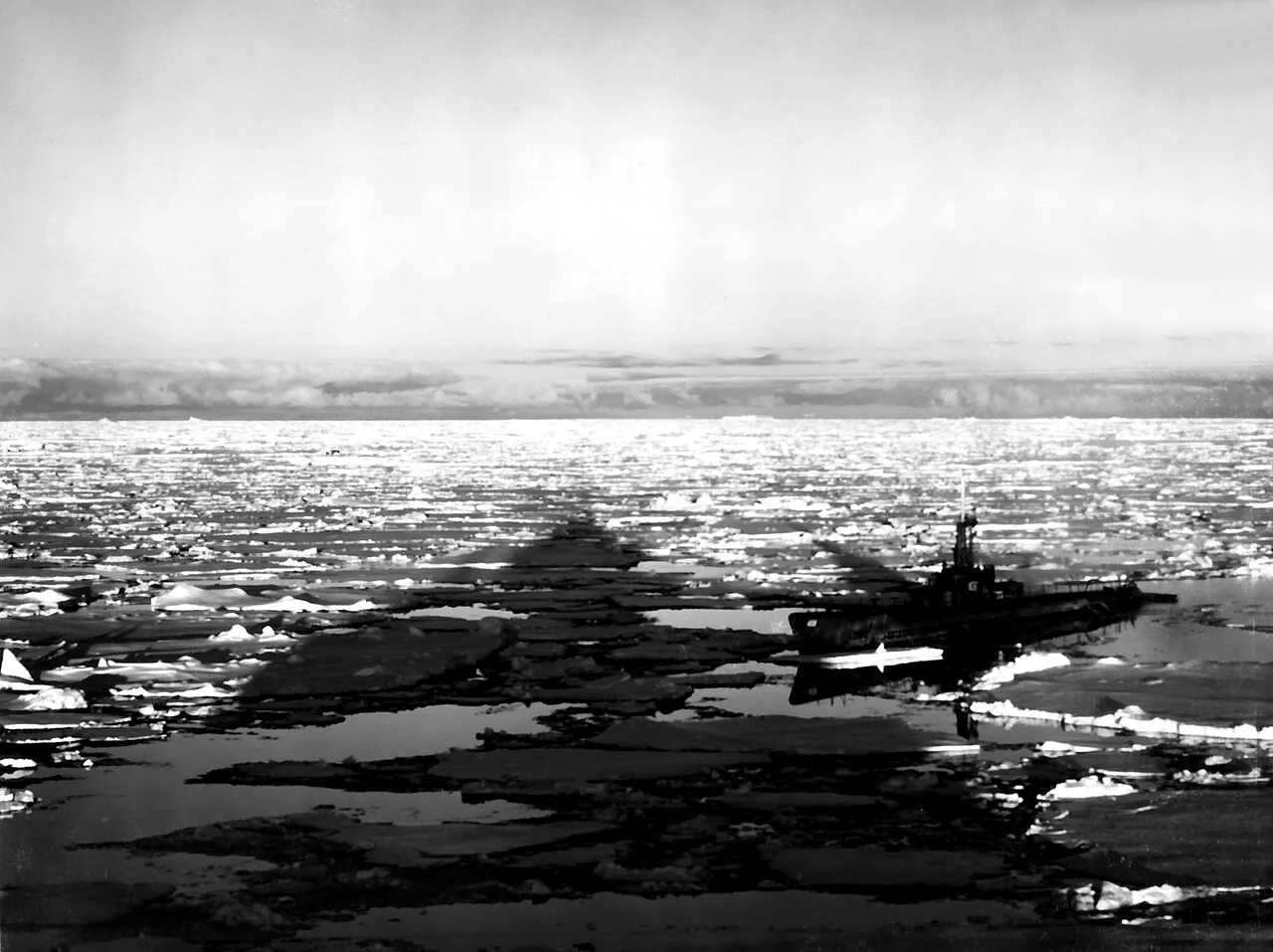
    The fleet carries everything needed in the ice: two icebreakers, two ships that serve as floating bases for flying boats, two destroyers, tankers, cargo ships and the submarine Sennet. Flying boats are aircraft that take off from and land on water. There are also helicopters, tracked vehicles and sled dogs.

    Here the legend is silent.

    The submarine Sennet in the pack ice, 1947. Photo: US Navy.

  3. December 1946Southern Ocean

    Three groups around a continent

    Off Antarctica the fleet splits into three groups. The Central Group with the flagship Mount Olympus heads into the Ross Sea, a large bay of the continent. There it is to build a base.

    The other two groups sail along the coast in opposite directions, one to the west and one to the east. Their flying boats are to photograph the rim of the continent from the air.

    On December 30 the Central Group assembles at Scott Island. Beyond it the pack ice begins, a wide belt of drifting ice floes.

    Here the legend is silent.

  4. December 30, 1946Thurston Island

    George 1 does not return

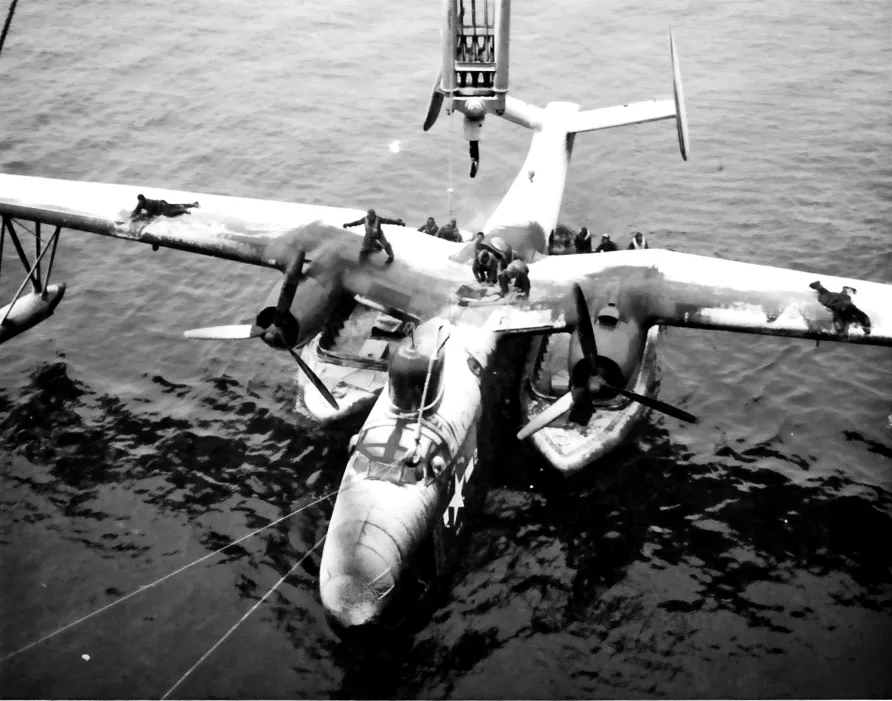
    At 2:24 a.m. the flying boat George 1 takes off from its tender, the Pine Island. Nine men are aboard, among them Captain Henry Caldwell.

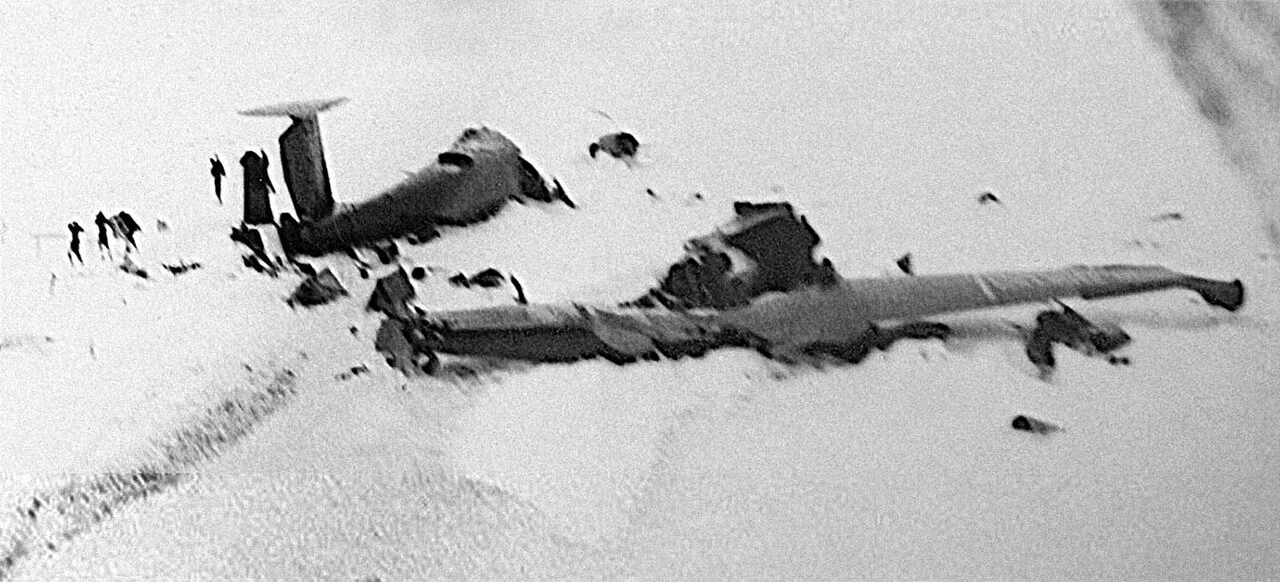
    Then blowing snow sets in. Sky and ice are both white, and the pilots can no longer tell where the ground begins. The aircraft strikes the ice near Thurston Island and burns. Three men die: Maxwell Lopez, Wendell Hendersin and Frederick Williams.

    The legend

    Later retellings with no contemporary source

    The aircraft was shot down, the legend says, and it was not the only one.

    The six survivors described an accident in driving snow. The three dead are still there today, deep under the ice.

    A PBM Mariner flying boat during the expedition. George 1 was an aircraft of this type. Photo: US Navy.

  5. January 11, 1947Thurston Island

    Thirteen days in the wreck

    Six men survive. The weather is so bad that nobody can search for them. For thirteen days they hold out in the fuselage.

    On January 11 a second flying boat, George 2, sights the wreck. The survivors make their way to the coast, where a third flying boat picks them up. Pilot Ralph LeBlanc loses both legs.

    Here the legend is silent.

    The wreck of George 1 on Thurston Island, photographed from the search aircraft on January 11, 1947. The survivors are standing on the left. Photo: US Navy.

  6. January 15, 1947Bay of Whales, Ross Sea

    A city of tents

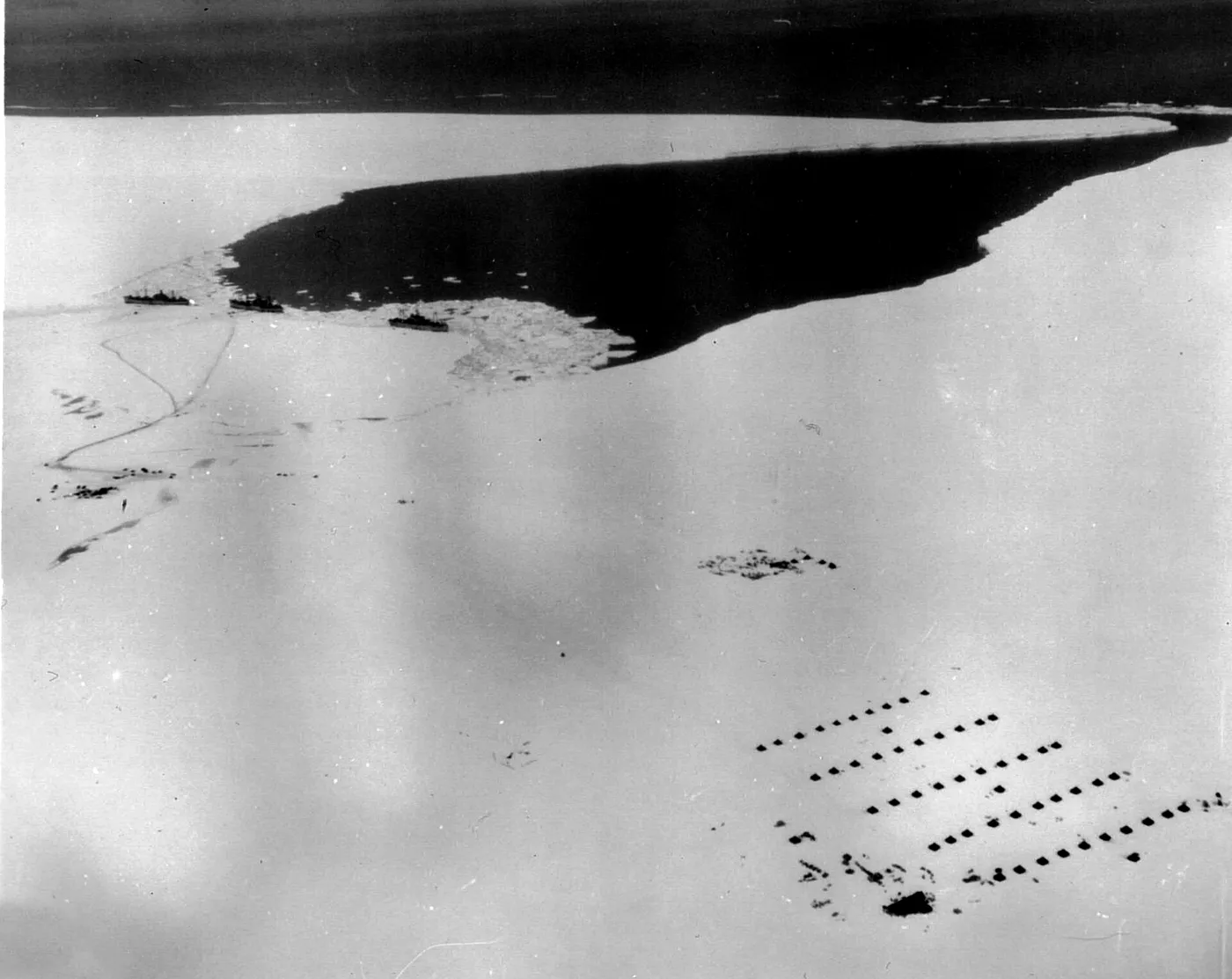
    The Bay of Whales is frozen over. The icebreaker Northwind cuts a harbor into the ice. Next to it the ice shelf begins, a thick slab of ice that reaches from the land out over the sea. On it the base Little America IV takes shape. It is the fourth base of that name.

    By early February there are tents, a Quonset hut, three runways of packed snow and a landing strip of steel matting. Up to 300 men live here.

    Here the legend is silent.

    Little America IV from the air, 1947. The rows of dots are tents. Photo: US Navy.

  7. January 21, 1947Bay of Whales

    The fourth death

    While unloading on the bay ice, seaman Vance Woodall of the cargo ship Yancey is killed in an accident.

    He is the fourth and last man to die on the expedition.

    While unloading on the bay ice, seaman Vance Woodall of the cargo ship Yancey is killed in an accident.

    He is the fourth and last man to die on the expedition.

    Here the legend is silent.

  8. January 29, 1947Aircraft carrier Philippine Sea

    Rocket-assisted takeoff

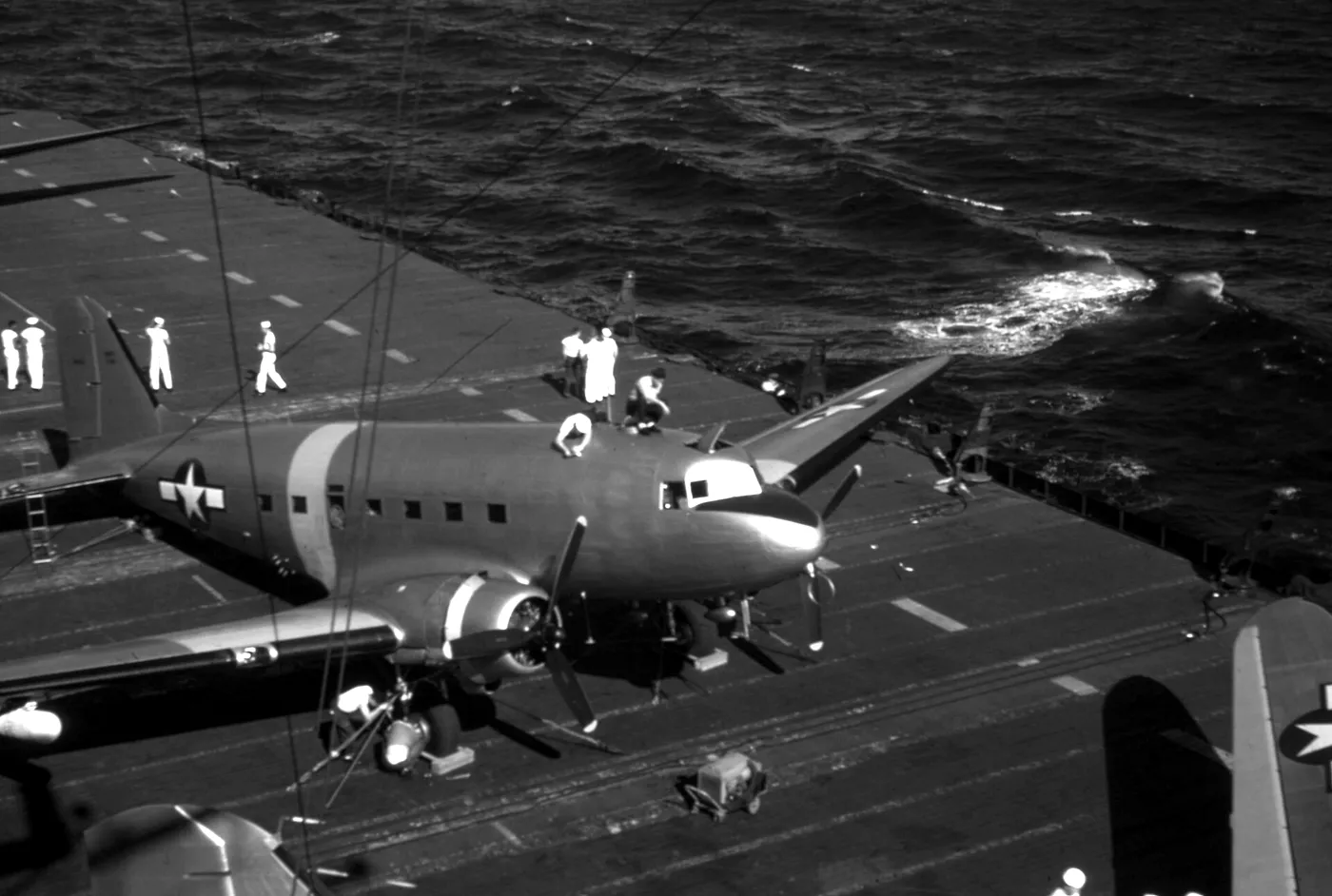
    On the carrier’s deck stand six twin-engine R4D transport planes. They are built for runways on land. A carrier deck is really too short for them.

    So they are fitted with rockets that give an extra push on takeoff. The first two aircraft get off that way, with Byrd in the first. By January 30 all six are at Little America IV. None of them can return to the carrier, because they cannot land on it.

    Here the legend is silent.

    R4D transports on the deck of the Philippine Sea, January 8, 1947. Photo: US Navy.

  9. Around February 1, 1947Coast of Wilkes Land

    The oasis

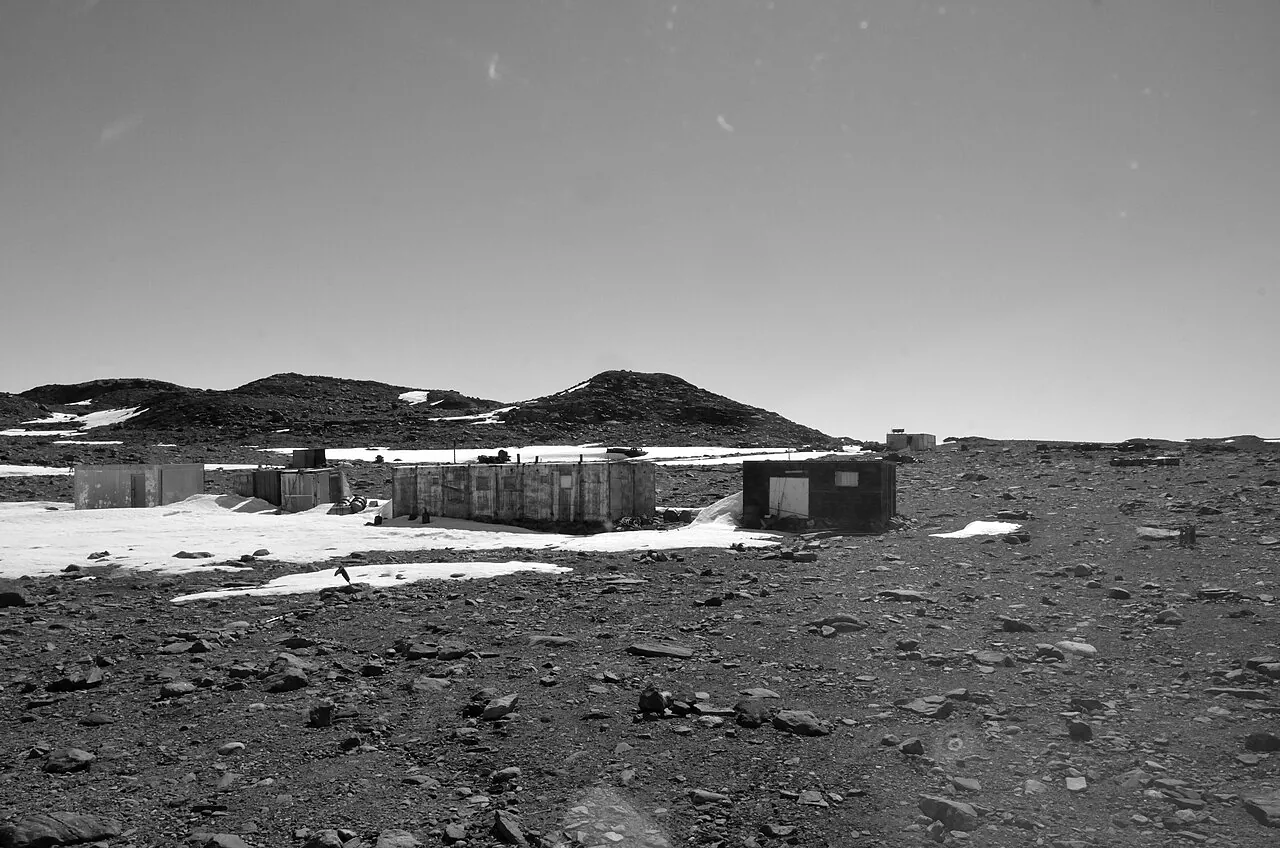
    Antarctica is almost completely covered in ice. Pilot David Bunger of the Western Group sees below him something that should not exist here: hills without ice and open lakes.

    A few days later he lands his flying boat on one of the lakes. The area has been called the Bunger Oasis ever since. It lies on the coast of Wilkes Land. Neuschwabenland, which becomes important in the legend later, is on the opposite side of the continent.

    Here the legend is silent.

    The Bunger Oasis in December 2016: bare rock instead of ice. The huts belong to a later research station. Photo: TobbeTardigrade, CC BY-SA 4.0, shown in greyscale.

  10. February 15 and 16, 1947South Pole

    Over the Pole

    Two aircraft fly from Little America IV to the South Pole and back.

    In all, the expedition’s aircraft bring back about 70,000 aerial photographs. Many cannot be turned into maps at first. That would require individual points on the ground to have been surveyed precisely, and those measurements are missing.

    Told since1990 · 43 years later

    The Missing Diary of Admiral Richard E. Byrd

    On February 19, 1947, the diary says, Byrd flies into a warm world inside the Earth, with green valleys and beings who are expecting him.

    The logbook has Byrd with the fleet in Antarctica that day. The diary sets the flight in the Arctic. Nobody has ever seen an original.

  11. February 23, 1947Bay of Whales

    Withdrawal

    In February the weather worsens and winter comes early. Flying is possible on only five days of the month. Flight operations end on February 22, and the next day the icebreaker Burton Island leaves the base.

    The six transport planes stay behind in the ice. By 1958 that part of the ice shelf has broken away. The aircraft have been lost ever since.

    The legend

    The legend, in later retellings

    The fleet fled, the legend says: beaten by flying objects faster than anything the Navy knew.

    The logbook records an early winter. It records nothing more.

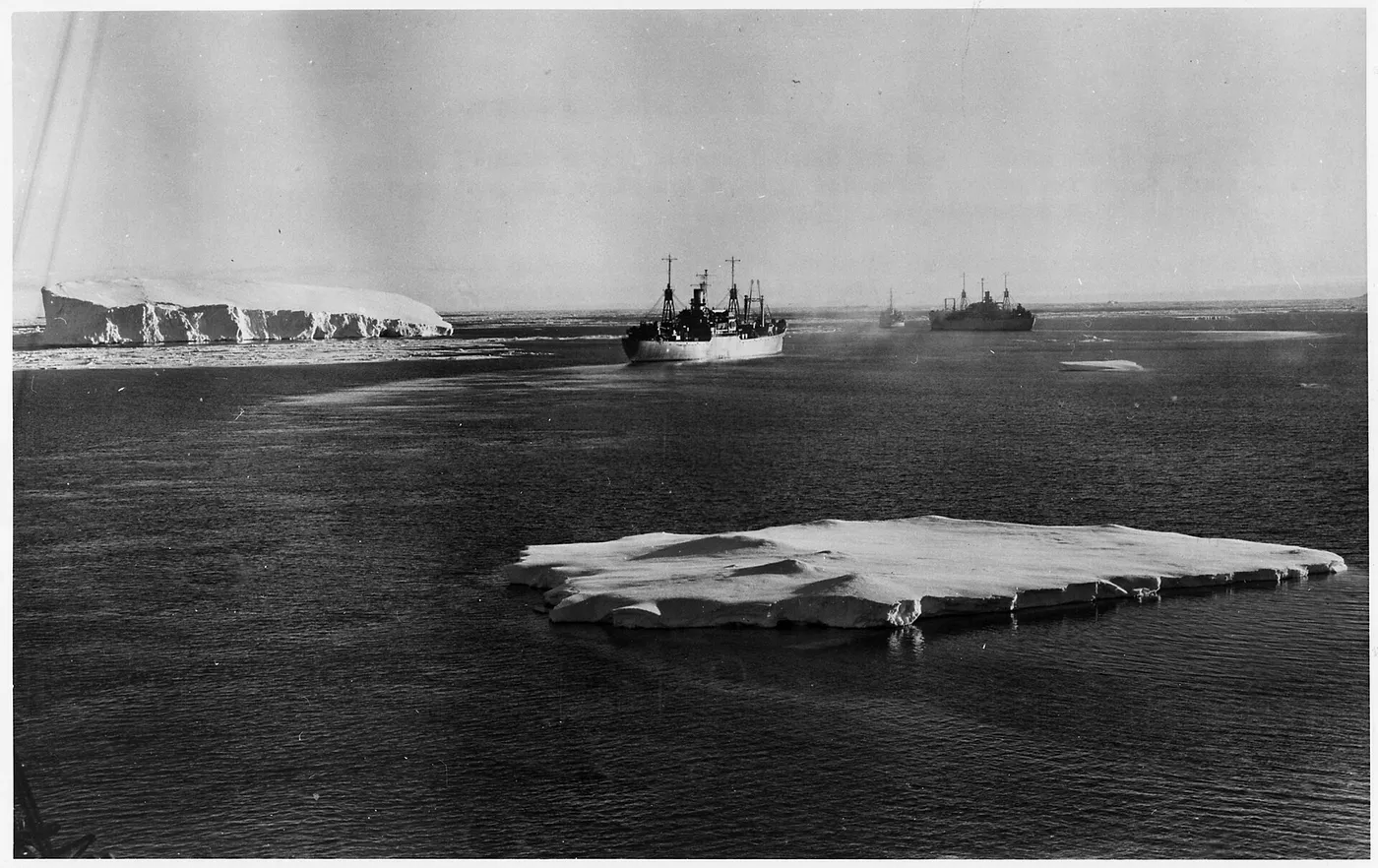
    The cargo ships Yancey and Merrick in the ice, 1947. Photo: US Navy, National Archives.

  12. March 5, 1947Aboard the Mount Olympus

    The interview

    On the voyage home Byrd talks to reporter Lee van Atta. The Chilean newspaper El Mercurio prints the interview on March 5.

    Byrd says the world is shrinking and great distances no longer protect the United States. The country must expect to be attacked by aircraft that can fly over one or both poles.

    The shortest route between the United States and the Soviet Union runs over the North Pole. That would be the obvious warning. But Byrd says: over one or both poles. He does not say what is supposed to come from the South Pole.

    Told since1975 · 28 years later

    Later English and German versions of the interview

    In later versions Byrd warns of flying objects that travel from pole to pole at incredible speed.

    The Spanish text in the newspaper says aircraft. Who added the speed has never been established.

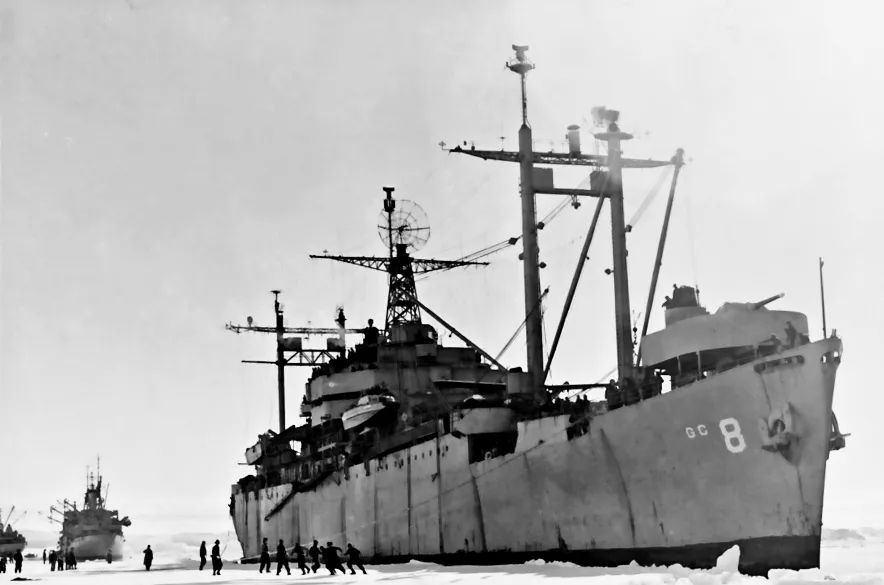
    The flagship Mount Olympus at the ice edge, 1947. Photo: US Navy.

  13. Act two · How the expedition became a riddle

    1939 and 1945Dronning Maud Land and Argentina

    Two older stories

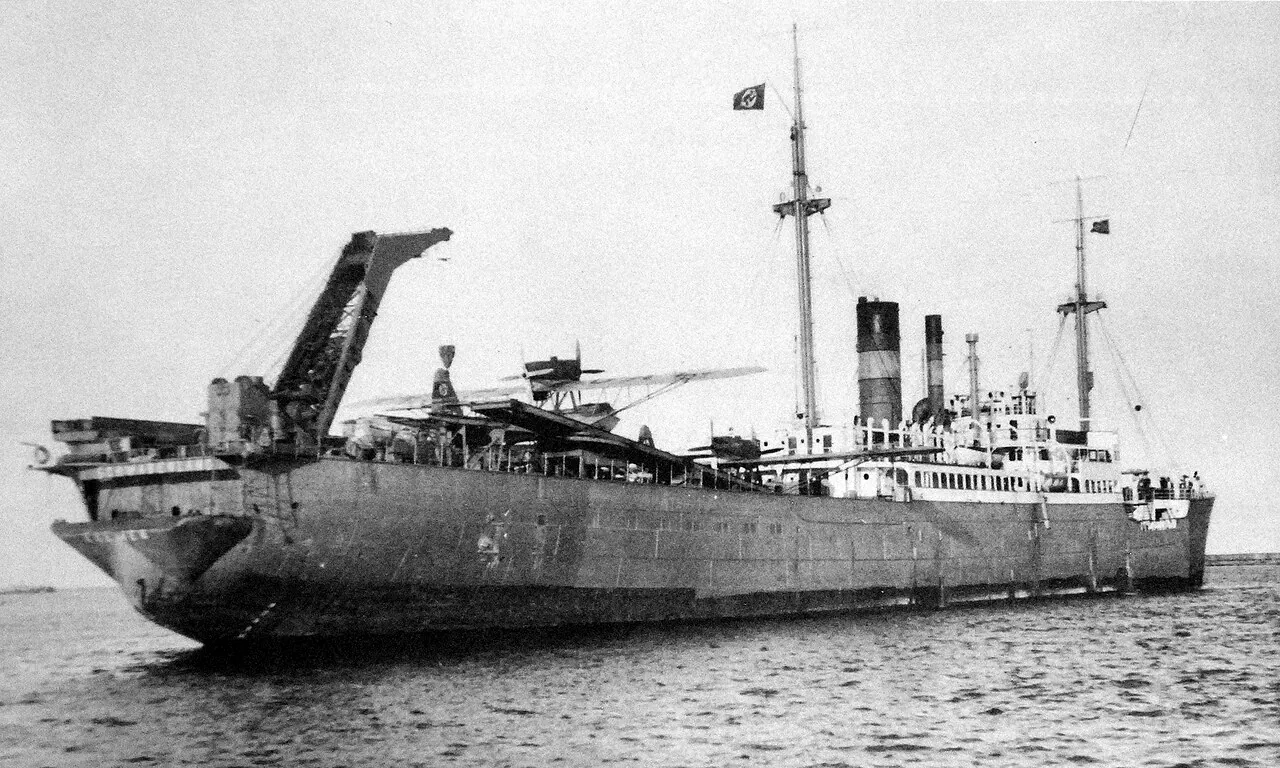
    The legend draws on two older stories. The first: in January and February 1939 a German expedition aboard the ship Schwabenland surveys a stretch of the Antarctic coast, Dronning Maud Land. It names the area Neuschwabenland and sails away again.

    The second: in July and August 1945, weeks after the German surrender, two German submarines turn up in the Argentine port of Mar del Plata, U-530 and U-977. The crew of U-530 has thrown the logbook overboard. The commander does not say exactly where the boat was in the meantime.

    In the records neither has anything to do with Highjump. In the legend they belong together.

    Here the legend is silent.

    The ship Schwabenland, 1939. Flying boats were launched from its deck by catapult. The picture comes from a US Navy recognition file of 1943. Photo via Library of Congress.

  14. 1964United States

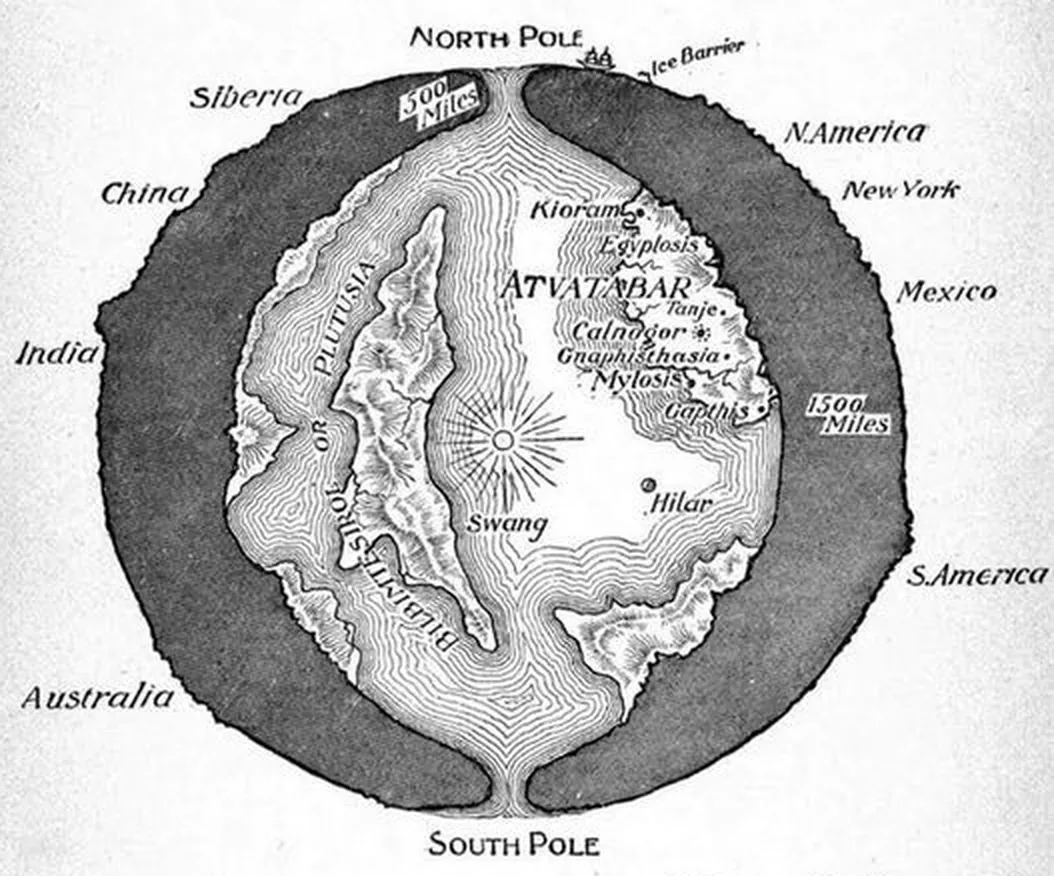
    The hollow Earth

    An author who calls himself Raymond Bernard, and whose real name is Walter Siegmeister, publishes the book The Hollow Earth. It claims there are openings at the poles that lead into the interior of the Earth. As his chief witness he names Byrd.

    Byrd can no longer object. He died in 1957.

    An author who calls himself Raymond Bernard, and whose real name is Walter Siegmeister, publishes the book The Hollow Earth. It claims there are openings at the poles that lead into the interior of the Earth. As his chief witness he names Byrd.

    Byrd can no longer object. He died in 1957.

    Here the legend is silent.

    The idea is far older than Bernard's book: map of the “Interior World” from the 1892 novel The Goddess of Atvatabar. Drawing: C. Durand Chapman.

  15. Mid-1970sToronto

    Flying discs from Neuschwabenland

    In the mid-1970s a book by the authors Mattern and Friedrich appears. It links the Byrd interview with alleged German flying discs and a secret base in Neuschwabenland. In it Highjump becomes an attack on that base.

    Behind the name Christof Friedrich is the publisher Ernst Zündel, a neo-Nazi. He tells the base in the ice as a story of Germans who were never defeated. Since then the legend has been out in the world, and nobody has been able to call it back.

    Here the legend is silent.

    Drawing based on the story: a flying disc from the side and from above. None has ever been found.

  16. 1990 at the latestUnited States

    The missing diary

    Under the title The Missing Diary of Admiral Richard E. Byrd an alleged secret diary appears. In it Byrd flies on February 19, 1947, from the Arctic into a warm world inside the Earth.

    On that day Byrd was with the fleet in Antarctica, at the other end of the Earth. Nobody has ever shown an original of the diary. Who wrote the text remains open to this day.

    Here the legend is silent.

    Drawing by BuchKnall, file note on the alleged diary: the entry for February 19, 1947 is set in the Arctic, while Byrd was in Antarctica that day.

  17. 2007Cambridge

    Two researchers do the sums

    Polar scientist Colin Summerhayes and Peter Beeching check the legend point by point. Their paper appears in Polar Record, a journal of polar research.

    Their findings: the Germans were at the coast only briefly in 1939. The two submarines were at sea in July and August, which is winter in the southern hemisphere. At that time the sea off Antarctica is frozen far out, and they could hardly have reached the coast.

    The two see Highjump as an exercise for a war in the Arctic. What remains is Byrd’s sentence about both poles.

    Here the legend is silent.

  18. To this dayCinema and internet

    The legend runs on

    In 2012 the film satire Iron Sky turns the Neuschwabenland story into a comedy. In many videos on the internet the same story is still told as fact.

    The expedition has a film of its own: The Secret Land, shot by Navy cameramen, won the 1949 Academy Award for best documentary feature. Nobody has seen the six abandoned aircraft since 1958.

    Here the legend is silent.

Unresolved facts

1

What did Byrd mean by both poles?

The shortest route to the Soviet Union runs over the North Pole. In El Mercurio Byrd speaks of aircraft that can fly over one or both poles. He does not say why he includes the South Pole.

2

Where was U-530?

The boat surrenders at Mar del Plata on July 10, 1945, two months after the war ended. The logbook and secret papers are in the sea, and the crew carry no identification. The commander does not say exactly where the boat has been since the war ended.

3

What was to be secured?

The orders list the aim of consolidating and extending US sovereignty over the largest practicable area of Antarctica. Sovereignty means: the territory is to belong to the United States. In public the Navy spoke of training and testing. Newspapers at the time wrote of a race for uranium.

4

Who wrote the diary?

The alleged secret diary appeared in 1990 at the latest from a small publisher. Who wrote the text is not known.

Logbook versus legend

Seven claims about Highjump that you often read. Tap a card to see what the records say about each.

In their own words

Six lines from people who were there and people who were watching, each with its source.

“… primarily a military mission to train naval personnel, test ships, planes and the new helicopters”

Richard E. ByrdPress conference, November 12, 1946as quoted by HistoryNet

“Consolidating and extending United States sovereignty over the largest practicable area of the Antarctic continent”

Admiral Marc A. MitscherObjective in the instructions to the task force commander, October 15, 1946as quoted by south-pole.com

“U.S. measures in Antarctica testify that American military circles are seeking to subject the polar regions to their control”

A Soviet naval journalafter the expedition was announced, 1946quoted in English by HistoryNet

“no weather stations, inhuman landscape, traditional navigation aids useless, maps limited”

A flying boat crew memberon flying in Antarcticaas quoted by HistoryNet

“… by aircraft that can fly over one or both poles.”

… por aviones que pueden volar sobre uno o los dos polos.

Richard E. ByrdInterview with Lee van Atta, El Mercurio, March 5, 1947excerpt from the Spanish wording

“Our hope is that now we have the entire material to make a detailed map of all of Antarctica.”

Richard E. Byrdafter the expedition ended, March 1947as quoted by HistoryNet

Sources

Image credits

  • Zeichnungen und Lagekarte: von BuchKnall, keine Originalbilder. Küstenlinien nach Natural Earth, gemeinfrei.
  • Fotos der Expedition: US Navy und National Archives, über Wikimedia Commons, gemeinfrei.
  • Bunger-Oase 2016: TobbeTardigrade, über Wikimedia Commons, CC BY-SA 4.0 (creativecommons.org/licenses/by-sa/4.0), in Graustufen umgewandelt.
  • Schwabenland 1939: aus einer Erkennungsmappe der US-Marine von 1943, Library of Congress, über Wikimedia Commons, gemeinfrei. Karte der „Inneren Welt“: C. Durand Chapman, 1892, gemeinfrei.
  • Musik: „Suspenseful Dark Background“ von Universfield. Schneesturm im Vorspann: „Howling Hissy Blizzard“ von tanweraman. Wind und weitere Geräusche: von BuchKnall, im Browser erzeugt.

How this file was made

Every statement on this page comes from the sources listed. We do not rule on everything: what is open stays open. Figures for the aerial photographs range from about 49,000 to about 70,000, and we give the more common one. The map is drawn, and routes and flight paths are approximate. The expedition photographs were taken by the US Navy, and every other picture names its origin in the caption. Two panels in the second act are our own drawings and are labeled as such.